

Originally published in ANM’s Through My Lens LinkedIn newsletter on July 19, 2026. Republished here with the original author attribution.
Original LinkedIn edition: Read the source article on LinkedIn.
Some moments quietly change the way you see the world. Not because someone sat you down and explained a theory. But because reality refused to fit the story you’d always believed.
For me, one of those moments was realising that I’d been looking for emotions in all the wrong places.
For years, I thought I knew what sadness looked like. I thought I knew what fear looked like. I thought I knew what love, excitement and anxiety looked like.
Then autism challenged every one of those assumptions.
I’ve watched autistic children laugh when they were overwhelmed. I’ve watched them become completely silent when they were terrified. I’ve seen children walk away from the people they loved most—not because they didn’t want comfort, but because their nervous systems simply couldn’t cope with one more demand.
I’ve watched parents apologise for children who were desperately trying to survive environments that overwhelmed them. And I’ve watched those same children be called rude, manipulative, stubborn or uncaring because the adults around them couldn’t recognise what was really happening.
One of the most damaging myths about autism continues to survive.
“Autistic children don’t feel emotions.”
Nothing could be further from the truth.
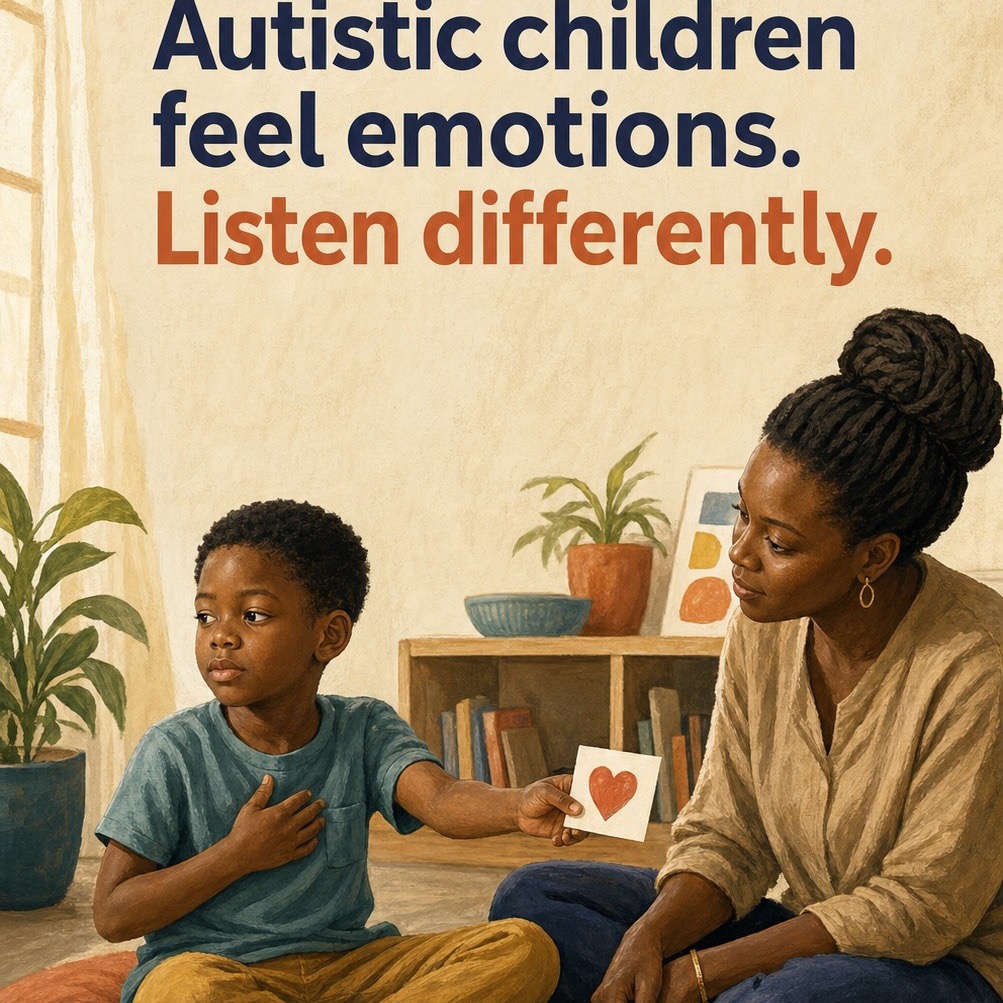
Autistic children feel joy. They feel grief. They feel fear. They feel disappointment. They feel love. They feel loneliness.
Often, they feel these emotions with remarkable intensity.
The difference is not usually whether they experience emotion.
It’s whether they’re able to recognise it, organise it and communicate it in ways the rest of us understand.
Research increasingly suggests that many emotional difficulties commonly attributed to autism are more closely associated with alexithymia—a separate trait affecting the ability to identify, understand and describe one’s own emotions. Around half of autistic people experience alexithymia, compared with a much smaller proportion of the general population. Alexithymia is not the absence of emotion.
It’s the absence of words.
That distinction matters.
Because when we misunderstand the problem, we almost always misunderstand the child.
I’ve heard people say,
“They don’t care.”
“They’re in their own world.”
“They’re emotionless.”
“They’re so detached.”
Every time I hear those words, I find myself thinking the same thing. We’ve confused communication with emotion. Those are not the same thing. We judge emotion by what we can see.
Tears.
Facial expressions.
Tone of voice.
Eye contact.
Words.
But what if those are simply our preferred languages of emotion?
What if we’ve spent decades mistaking familiar communication for genuine feeling?
An autistic child doesn’t have to cry for their pain to be real.
They don’t have to make eye contact for their love to be genuine.
They don’t have to say, “I’m anxious,” for anxiety to be consuming every part of their body.
Imagine your heart racing. Your stomach tightening. Your breathing changing. Your muscles becoming tense. Your skin feeling as though it is buzzing.
Now imagine not knowing whether what you’re experiencing is excitement, fear, exhaustion, hunger, illness or anxiety.
Now imagine everyone around you demanding an explanation before you’ve even worked out what you’re feeling yourself.
That is an experience many autistic people with alexithymia describe.
No wonder emotions can seem confusing.
No wonder meltdowns appear to come “out of nowhere.”
But the older I get, the less I believe they ever come out of nowhere.
The signs were almost always there. The child simply couldn’t recognise them. Or couldn’t communicate them. Or nobody recognised what they were trying to communicate.
That has completely changed the questions I ask.
I no longer ask,
“Why won’t they tell me what’s wrong?”
Instead, I ask,
“Do they know what they’re feeling yet?”
That is an entirely different conversation. And perhaps a much kinder one.
I’ve also come to appreciate how important interoception is in this story.
We often expect children to name emotions before we’ve helped them notice the physical sensations that come first. Anxiety often begins as a racing heart. Frustration might first appear as tight shoulders. Overwhelm may feel like buzzing skin, aching muscles or a pounding headache.
If recognising those body signals is already difficult—as it often is for autistic people with interoceptive differences—then asking, “How do you feel?” may actually be asking them to skip several important steps.
Perhaps the first question shouldn’t be about emotions at all.
Perhaps it should be,
“What is your body telling you?”
The longer I spend listening to autistic people and their families, the less interested I become in changing behaviour.
I’m far more interested in understanding what that behaviour is trying to protect.
Because behaviour rarely appears without a reason.
A child covering their ears may be saying,
“Everything feels too loud.”
Walking away might mean,
“I need space before I fall apart.”
Repeating the same sentence again and again may be an attempt to create predictability when everything else feels frighteningly unpredictable.
Even laughter isn’t always happiness. Sometimes it’s a nervous system trying desperately to regulate overwhelming emotion. These are all forms of communication.
The challenge is that they aren’t the forms most of us were taught to recognise.
Living and working across African communities has made me reflect on something else, too. I sometimes wonder whether many autistic children carry two burdens instead of one.
The first is learning to navigate a world that wasn’t designed for their nervous systems.
The second is trying to meet cultural expectations that value obedience, emotional restraint and immediate explanations.
In many African homes, “Explain yourself” isn’t simply a question. It’s an expectation. Respect means answering. Respect means greeting properly. Respect means looking at adults when they speak. Respect means explaining why you’re upset.
But what if a child genuinely cannot explain something they don’t yet understand themselves?
Sometimes I think we’ve expected emotional skills before we’ve ever taught emotional language.
That isn’t fair.
I’ve had to challenge those assumptions in myself, too.
I no longer assume silence means there is nothing to say.
Sometimes silence is a child trying to understand an internal experience that hasn’t yet become words.
I’ve also stopped expecting emotional expression to look familiar before I believe it. Because the more autistic adults I listen to, the more I realise how often they spent childhood being misunderstood rather than unemotional.
Research—and lived experience—continue to remind us that behaviour is communication.
So perhaps the question is no longer,
“Why are they behaving like that?”
Perhaps the better question has always been,
“What are they trying to tell me?”
That small shift changes everything.
Instead of saying,
“Use your words.”
We can say,
“Let’s work this out together.”
Instead of,
“Calm down.”
We can ask,
“What is your body trying to tell you?”
Instead of,
“You’re overreacting.”
We can respond,
“Something feels too much right now. Let’s figure it out together.”
And sometimes the kindest response isn’t another question at all.
Sometimes it’s making the room quieter.
Turning down the lights.
Reducing the demands.
Sitting nearby without expecting conversation.
Accepting communication in whatever form the child can manage—speech, movement, pictures, writing, gestures or quiet.
Giving them time.
Because autistic children should never have to perform emotion in ways that make other people comfortable before we believe their feelings are real.
I’ve stopped asking whether autistic children feel deeply.
I know they do.
The question that stays with me now is a different one.
Have we learned enough about autism to recognise those feelings when they don’t look like our own?
Because perhaps the communication gap was never only theirs.
Maybe some of it has always been ours.
Reflection
What is one way an autistic child in your life communicates emotion without words?
Sometimes the most important conversations are the ones that never involve speech.