Originally published in ANM’s Through My Lens LinkedIn newsletter on July 30, 2026. Republished here with the original author attribution.
Original LinkedIn edition: Read the source article on LinkedIn.
I was privileged to attend my senior secondary school in Norway. It was an incredible opportunity, and it shaped me in ways I did not fully understand at the time. Norway taught me many things—but one lesson only revealed itself years later: support is not a privilege; it is access.
Through Youth for Understanding, I lived with a host family, attended a local upper secondary school and continued joining camps and outings after my exchange year. That experience fed a love of different cultures that has stayed with me.
Years later, I even completed a certificate in intercultural communication and studied Religion and Culture.
But something else from Norway has stayed with me.
The lesson I didn’t understand at the time
During exams, I noticed that some students were given extra time. I did not understand why. If I am honest, I did not make much effort to find out either.
When I later went to university, we were reminded at the beginning of each semester that there was a deadline for applying for special examination arrangements. This time, I asked questions. I began to understand that some students needed adjustments to have a fair opportunity to demonstrate what they knew.
Extra time was not an unfair advantage. It was support.
That distinction matters.
The questions that came after diagnosis
Since receiving my diagnosis, I have spent a great deal of time looking back at my life with new eyes. I have been learning how my brain works, why certain things were harder than they appeared to be for other people, and why I found ways to cope that nobody else could see.
Naturally, I have wondered whether those examination arrangements might have helped me.
I cannot know exactly what would have changed. Perhaps my results would have been different. Perhaps I would simply have been less exhausted. Perhaps I would have understood that struggling did not mean I was lazy, careless or not trying hard enough.
That is one of the painful things about a late diagnosis: it gives you answers, but it also introduces you to all the support you did not know you were allowed to need.
I have mixed feelings about labels. Too often, people see the label before they see the person. They learn a diagnostic term and believe they now understand everything about you.
They do not.
But having language for my experience would still have helped me. A diagnosis would not have changed who I was. It might, however, have helped me explain what I needed without feeling that I was making excuses.
What did our schools fail to see?
My reflections do not stop in Norway.
I think about the schools I attended before then: primary school in Zimbabwe, followed by junior and senior secondary school in Botswana.
My first primary school was what we called a Group A school. These were historically better-resourced schools associated with Zimbabwe’s (then Southern Rhodesia) racially segregated colonial education system. By the time I attended, Black children were just starting to be admitted, but the history of unequal access still mattered.
The school had what I remember being called a “special class”. Yet I do not remember meaningful support being available to children in mainstream classrooms whose difficulties were less visible.
There was little recognition of
· The child who appeared capable but could not finish an examination on time.
· The child whose attention wandered despite trying desperately to concentrate.
· The child overwhelmed by noise, instructions or transitions.
· The child who performed well enough to avoid concern while paying an enormous private cost.
Some of us learnt to mask. We copied what other children did, stayed quiet, worked twice as hard or blamed ourselves.
Because we were not disruptive enough, we were often not noticed.
This is why the African Neurodiversity Movement exists
To ensure that no child’s potential depends on whether a teacher happens to notice their struggle.
This is why awareness cannot be the finish line for the African Neurodiversity Movement. Knowing that autism, ADHD, AuDHD and other forms of neurodivergence exist is not enough.
Awareness without practical change leaves children in exactly the same classrooms, facing exactly the same barriers.
Support should not live somewhere else
When a learner needs support, the first response should not automatically be removal from the mainstream classroom.
Special educational needs (SEN) teachers, occupational therapists and other professionals have valuable expertise. That expertise should not be confined to separate institutions. It should also be brought into ordinary schools, where it can help teachers understand and support a wider range of learners.
This does not mean pretending that every child has identical needs. It means building a system flexible enough to respond to real human differences.
That work should begin in teacher-training colleges and universities. Every new teacher should enter the classroom with a practical understanding of neurodivergence, sensory needs, executive functioning, communication differences and reasonable accommodations.
Schools also need clear ways to identify support needs without waiting for a family to obtain an expensive private diagnosis. Adjustments such as additional time, movement breaks, quieter spaces, instructions in different formats and alternative ways of demonstrating knowledge should be understood as access measures—not favours.
Zimbabwe already has policies and guidance supporting inclusive education. The Ministry of Primary and Secondary Education’s practical handbook calls for inclusive enrolment, teaching and learner-support services in every school. Yet UNICEF has continued to document serious gaps in access, resources and implementation.
This is the uncomfortable truth: a progressive policy does not support a child until somebody puts it into practice.
A child is more than a set of points
Our education systems also need to reconsider what they count as success.
When a learner leaves school with zero points, we record the learner’s failure. We rarely record what the system failed to recognise.
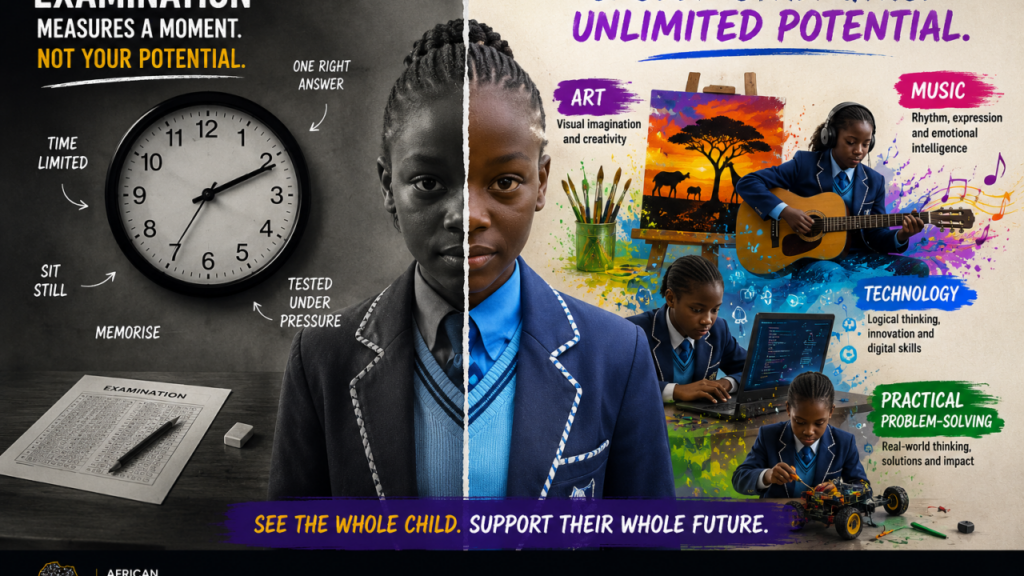
Academic examinations measure particular abilities under particular conditions. They do not capture every form of intelligence, creativity or potential.
Some neurodivergent learners may thrive through art, music, technology, design, practical work, entrepreneurship or other skills that are treated as secondary in a heavily examination-driven system. These are not consolation prizes for children who “could not cope” academically. They are legitimate abilities that can support meaningful work, independence and participation in community life.
Supported education should help learners discover and develop those abilities before years of failure damage their confidence.
The aim is not to lower expectations. It is to stop confusing one narrow route to achievement with human potential itself.
We cannot recover the past, but we can change what happens next
I sometimes wonder what earlier support would have changed for me. I cannot go back and find out.
What I can do is use what I now understand to ask better questions for the children coming after us.
· Who is struggling quietly?
· Who has been labelled lazy when they are overwhelmed?
· Who understands the work but cannot demonstrate that understanding in the required format?
· Who has a strength that the current curriculum has never given them a chance to show?
Those questions take us beyond awareness and towards inclusion, participation and occupational justice.
A child should not have to reach adulthood, receive a diagnosis and then look back at an education filled with support that was technically possible but never offered.
I cannot rewrite my past, but I can help rewrite the future of African classrooms.
We have missed enough opportunities already.
Practical action: If you are an educator, ask one learner this week,
“What makes it easier for you to learn and show what you know?”
Then listen without immediately defending the system.
Join the conversation: What support do you wish had been available to you—or to your child—at school?
#AfricanNeurodiversityMovement #InclusiveEducation #NeurodivergentLearners #AutismAfrica #ADHDAfrica #EducationForAll #DisabilityInclusion #OccupationalJustice #DifferentMindsUnitedAfrica