

Originally published in ANM’s Through My Lens LinkedIn newsletter on July 28, 2026. Republished here with the original author attribution.
Original LinkedIn edition: Read the source article on LinkedIn.
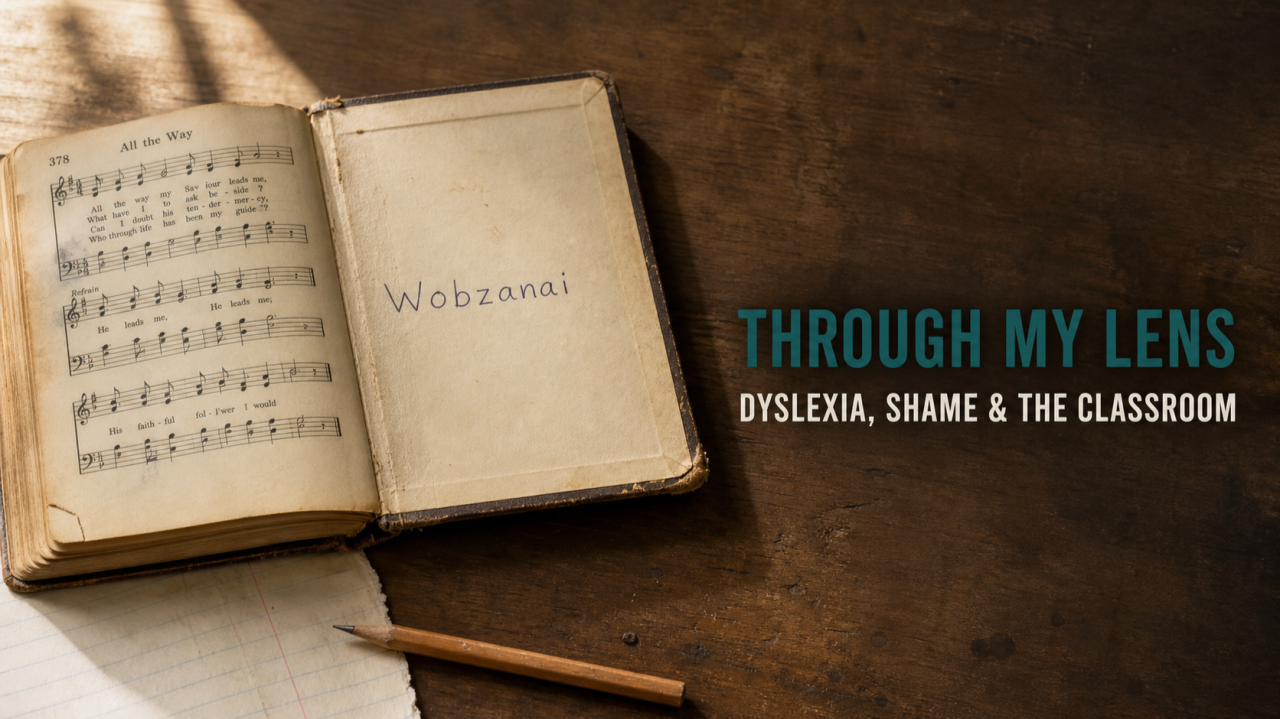
Wobzanai.
I wrote that inside my mother’s hymn book. My name is Wadzanai. I was young; I mixed up the letters and “Wobzanai” became a family joke. Fortunately, it was a passing phase. The mistake did not follow me into every classroom. It did not become proof that I was lazy or not trying hard enough.
But what if it had not passed? What if spelling and reading remained difficult no matter how hard I tried? What would it feel like to have something your brain genuinely struggles with turned into a joke?
That is not hypothetical for many people with dyslexia.
For them, ridicule can be obvious or hidden inside accepted teaching practices.
For many dyslexic children, young people and adults, that is not an imaginary question. It is part of everyday life.
And sometimes the ridicule is obvious. Other times, it is hidden inside teaching practices we have accepted as normal.
The teacher who saw potential in me
At junior high, I had a favourite teacher, Mrs Ryan. She saw potential in me and pushed me to expect more.
She also treated some classmates differently: giving me the unabridged book and often calling on the “slower learners” to read aloud.
At the time, I was pleased to be trusted. Looking back, I see how little language we had for hidden learning differences. We called children “slow” and carried on.
Some classmates may have been learning in an unfamiliar language; some may have had dyslexia, ADHD, anxiety, or other unmet needs. Whatever the cause, being asked to demonstrate difficulty aloud can teach a child to disappear.
Years later, I became the person trying to disappear
Fast-forward many years, and I was terrified of being called on to speak. I avoided eye contact; I stayed silent even when I had something to say. Silence does not mean nothing is happening inside.
My experience is not the same as dyslexia. Dyslexia, PDA and anxiety are different things, and we should not casually collapse them into one condition.
But the feeling of being exposed can cross those boundaries.
I know what it is like to have something to say and still be unable to say it on demand. I know that silence does not mean nothing is going on inside. I know that avoiding eye contact does not necessarily mean someone is uninterested, disrespectful or unprepared.
Sometimes it means: Please do not put me on the spot.
That has changed the way I think about participation.
Reading aloud is not a neutral activity.
For a confident reader, it may be routine; for another, it can expose a deeply personal difficulty.
Dyslexia is not a lack of intelligence or motivation.
It is a way some brains process language and symbols, and it looks different across ages, languages, and classrooms.
A child with dyslexia may have thoughtful answers, a strong imagination or excellent spoken language—but struggle to get those ideas onto paper.
That gap can be confusing. It is also real.
Signs families and teachers may notice
A learner may:
Read slowly, inaccurately or with great effort.Struggle to connect letters with their sounds.Find it difficult to blend sounds into words.Make persistent spelling mistakes.Need much longer to complete reading and writing.Avoid reading aloud because it causes embarrassment.Explain something clearly when speaking but struggle to express it in writing.
One sign alone does not confirm dyslexia. We look for a persistent pattern, the teaching the learner has received and how the learner responds to additional support.
That matters in African classrooms.
Many learners are taught and assessed in a language different from the one they know best.
A child may be navigating both literacy and a new language while sitting in a large class with limited individual support.
This does not cause dyslexia, but it can make identification more complicated. It can also make careless labels even more harmful.
We must stop treating “reads slowly” as a description of the whole child.
Slow reading does not mean slow thinking.
Poor spelling does not mean poor understanding.
Silence does not mean an empty mind.
And calling on a struggling learner without warning is not automatically inclusion.
Sometimes it is exposure dressed up as participation.
Calling on a struggling learner without warning is not automatically inclusion; sometimes it is exposure dressed up as participation.
Good teachers can still get things wrong.
I still believe Mrs Ryan was a brilliant teacher. Both things can be true.
Mrs Ryan changed my life and, like many caring teachers, she used practices we now understand differently.
This is not blame; it is learning.
Educators work with large classes, limited resources, and little training in dyslexia and neurodiversity. Once we know better, we must do better.
Before asking a learner to read aloud, ask:
Does the learner know in advance? Have they had time to practise? Can they decline without embarrassment? Are we assessing reading or knowledge? Could they participate by reading with a partner, recording themselves, or answering another way? Are we providing private reading support? Have we created a classroom where mistakes are handled with dignity?
Support does not mean never challenging a learner. Mrs Ryan taught me the value of being challenged.
But there is a difference between challenge and exposure.
Challenge says, I believe you can grow, and I will support you.
Exposure says, Perform this difficult task now, in front of everyone, and deal with whatever happens.
The lesson I carry with me
When I think about “Wobzanai” now, I still understand why my family found it funny.
But I also see the other side.
A misspelt word can be a passing mistake or one small sign that a learner needs support. Adults should be curious before we become critical.
Ask what makes the task difficult, what happens with more time, which language the learner understands best, whether they can explain the answer verbally, and what support has already been tried.
Ask without making the child feel defective.
There may be an intelligent, creative, capable person sitting quietly in that classroom—avoiding eye contact, hoping not to be called, carrying far more inside them than we have allowed them to show.
Let us stop using humiliation as a teaching tool. Let us build classrooms where learners are challenged without being shamed, supported without being labelled, and heard without first having to prove their brains work like everyone else’s.
What families can do
Change the language around the child. Replace “lazy,” “careless” or “not serious” with: “I can see this is difficult. We will work out what support you need.”
Write down what you notice. Record examples of reading, spelling and homework difficulties. Note what happens in each language the child uses.
Speak with the teacher. Ask which part of reading is difficult: recognising sounds, decoding words, reading fluently, spelling or understanding the text.
Request appropriate support. If difficulties continue despite targeted teaching, ask whether screening or a fuller assessment by a suitably trained professional is available. Screening can identify risk; it is not, by itself, a diagnosis.
Keep stories enjoyable. Read aloud, tell family stories and discuss books in the language your family uses most confidently. Audiobooks can help children access ideas while they continue developing reading skills.
What schools can do now
Effective early reading teaching includes direct, carefully sequenced instruction in speech sounds, letter–sound relationships, decoding, spelling and meaningful reading practice.
Learners need modelling, guided practice, feedback and regular monitoring—not instructions to guess unfamiliar words from pictures.
Schools can also:
Give instructions verbally and in writing.Break long tasks into smaller steps.Allow additional time or short breaks where needed.Provide audio, text-to-speech or larger-print materials when available.Allow oral or typed responses when spelling is not the skill being assessed.Avoid forcing a learner to read aloud without preparation.Recognise effort privately instead of comparing the child publicly.Agree on support with the family and review whether it is helping.
Accommodations do not make learning “easy” or lower expectations. They give a learner a fairer way to access information and demonstrate knowledge. They should be matched to the individual child. (International Dyslexia Association accommodation guidance)
Support does not have to begin with expensive equipment
A teacher can use handmade letter cards, bottle tops or stones to practise sounds and word-building. A family member can read a short passage aloud before the child rereads it with support.
These activities are not substitutes for specialist assessment or targeted intervention where those are needed. But a lack of resources should never become an excuse for ridicule, punishment or doing nothing.
What classroom practice made you feel included—or exposed—as a learner?
Share your experience in the comments. It may help a parent or teacher see a child differently.
Learn more about neurodiversity and inclusive education at:
@africanneurodiversitymovement
#ThroughMyLens #DyslexiaAwareness #NeurodiversityAfrica #InclusiveEducation #AfricanEducation #LearningDifferences #PDA #AnxietyAwareness