

Originally published in ANM’s Through My Lens LinkedIn newsletter on August 3, 2026. Republished here with the original author attribution.
Original LinkedIn edition: Read the source article on LinkedIn.
Last week, I found myself craving a combination I had not had in years.
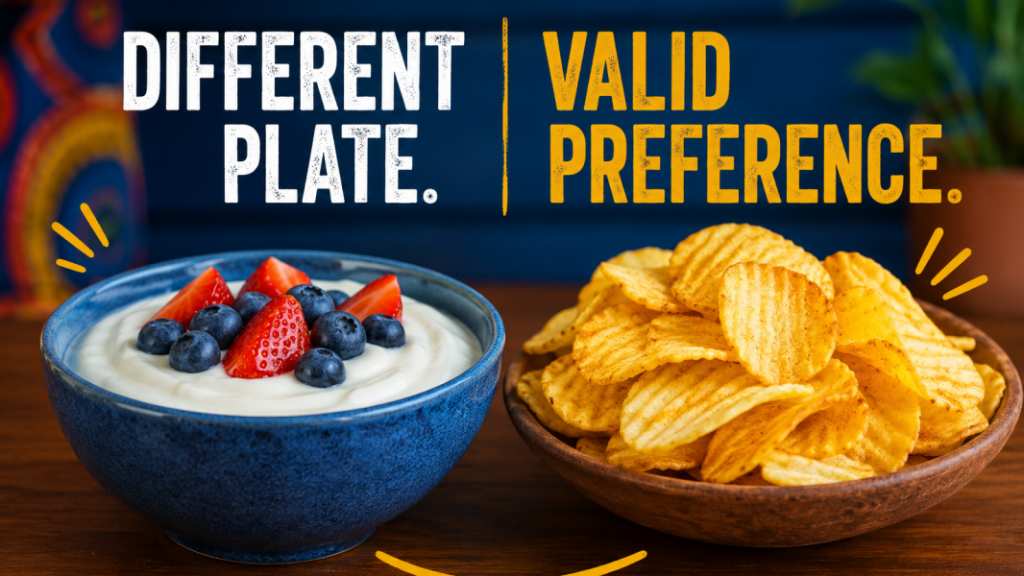
Yoghurt and crisps.
Together.
Crisps dipped in yoghurt.
Before you say, “That’s a strange combination,” pause for a moment.
Because for some neurodivergent people, food is about far more than taste.
And sometimes the things that look unusual from the outside make perfect sense when you understand the story behind them.
I first developed this habit during my secondary school years.
At the time, I did not think much about it. I certainly did not have the language to explain it. I simply knew that cold, smooth yoghurt and crunchy, salty crisps made me feel better.
Years later, I understand why.
But to explain that, I need to take you back to a different time.
A Fifteen-Year-Old Trying to Find Solid Ground
When I was fifteen, I left everything familiar behind.
My parents.
My brothers, including my younger brother, who could be wonderfully annoying.
My home.
My routines.
My friends.
My language, culture, and sense of belonging.
I moved thousands of miles away, alone, to participate in an exchange program.
Looking back, I recognise how fortunate I was to have that opportunity. But at fifteen, opportunity was not what I felt.
I felt loss.
I felt disorientation.
I felt the exhausting pressure of having to start over.
What nobody knew then, including me, was that I was navigating all of this as an undiagnosed neurodivergent teenager.
Every day required learning a new language, new social rules.
Every conversation felt like decoding a language everyone else seemed to understand naturally.
Every friendship carried uncertainty.
I spent a great deal of energy trying to fit in, trying not to stand out, trying to make sense of a world that suddenly felt unfamiliar.
And somewhere in the middle of all that, yoghurt and crisps became my thing.
At the time, I would never have called it sensory regulation.
I simply knew that something about the coolness of the yoghurt and the sharp crunch of the crisps helped me settle.
It was comforting.
Predictable.
Reliable.
When so much around me felt uncertain, that combination never did.
More Than Just Food
Years later, after learning more about my own neurodivergence, the pattern became clearer.
What looked like a strange food habit was actually serving a purpose.
For many neurodivergent people, food is not simply nutrition.
Food can be sensory input.
Food can be comfort.
Food can be regulation.
Food can be a way of creating predictability in a world that often feels overwhelming.
The appeal may have little to do with whether something is considered a “normal” combination.
Instead, it may be about texture, temperature, smell, familiarity, or how certain foods make the body and mind feel.
The contrast between yoghurt and crisps now seems obvious to me.
One is smooth, cool, and predictable.
The other is crunchy, stimulating, and satisfying.
Together, they created a sensory experience that worked.
And sometimes the explanation is even simpler than neuroscience.
Sometimes people like what they like.
Understanding Safe Foods
Many neurodivergent people have what are often called safe foods.
These are foods that feel familiar, comfortable, and reliable, especially during periods of stress, change, sensory overwhelm, or emotional exhaustion.
A safe food is not usually about stubbornness.
It is not necessarily about being “difficult.”
And it is certainly not always about poor parenting.
More often, it is a form of self-regulation.
A way of creating stability when the world feels unpredictable.
Safe foods are often:
Eaten frequentlyConsistent in taste and texturePreferred from specific brandsRelied upon during stressful periodsHelpful in restoring calm, focus, or emotional balance
For some people, yoghurt may become a safe food because of its smooth texture and predictability.
For others, crunchy foods such as crisps provide sensory feedback that feels regulating and satisfying.
The important point is not the food itself.
The important point is the function it serves.
An African Conversation About Food
This is where culture matters.
Across many African communities, food is deeply social. Meals are shared. Hospitality is valued. Being encouraged to eat is often an expression of love.
Often part of street culture (tuck shops, corner stores, Lyonsmaid or Dairyboard man on his bicycle peddling through the neighbourhood)
These are beautiful traditions.
But they can sometimes create challenges for neurodivergent children and adults whose sensory needs are not understood.
A child who refuses certain foods may be labelled fussy. A teenager who prefers familiar foods may be told they are being difficult. An adult who avoids particular textures may be teased for being immature.
I know this experience is not limited to childhood.
To this day, I have strong preferences around tea, porridge and cereal. If it contains milk, I do not want sugar in it. Not a little. Not “just to taste.” None.
It sounds insignificant until culture enters the picture.
Years ago, while visiting my then fiancé’s family during winter, a large pot of sweet milky tea was prepared as a gesture of welcome and hospitality. Now, if you have any Zimbabwean in you, you know that tea hobvu is almost a meal in itself. Rich, milky tea. The kind that warms you from the inside out.
And as a makoti or muroora, a new or soon-to-be daughter-in-law, the pressure can feel immense. First impressions matter. Family stories have a long shelf life. Nobody wants to become “the muroora who refused tea at her in-laws.”
What should have been a simple cup of tea suddenly became a social negotiation.
Refusing it felt uncomfortable because, across many African communities, accepting food and drink is about far more than consumption. It is about respect, relationship and belonging.
How do you explain that the problem is not the tea itself, but the sensory experience of sugar and milk together?
How do you explain that you are not rejecting the hospitality, the family, or the gesture?
You are simply trying to navigate a sensory experience that feels overwhelming or uncomfortable to you.
In many families, comments about what is on someone’s plate are considered normal conversation.
Yet for neurodivergent people, those comments can slowly become something else.
Shame.
The message becomes:
“Why can’t you just eat what everyone else is eating?”
“Why are you making things difficult?”
“Stop being picky.”
But what if that person is not being difficult?
What if they are simply trying to navigate a sensory world that others cannot see?
What if the issue is not the food at all, but our assumption that everyone experiences food in the same way?
Curiosity Over Judgment
Too many neurodivergent children grow up having their food preferences mocked, dismissed, or forced away.
We often assume that discomfort builds resilience.
In reality, shame rarely creates a healthy relationship with food.
Curiosity works better.
Support works better.
Listening works better.
Instead of asking, “Why are you being so difficult?” we could ask:
“What feels comfortable?”
“What makes eating easier for you?”
“How can I support you?”
Keeping familiar foods available, introducing new foods gradually, and seeking professional support when nutrition becomes a concern are often far more effective than pressure or punishment.
Food should not become a daily battle.
A Bowl of Yoghurt and a Packet of Crisps
These days, whenever I find myself reaching for yoghurt and crisps, I smile.
Not because it is a combination everyone should try.
And not because I think it is particularly sophisticated.
I smile because I understand it differently now.
What looked like a quirky habit was actually a young neurodivergent person finding a way to cope.
Finding something predictable.
Finding something comforting.
Finding a small sense of safety in a world that had suddenly changed.
Sometimes understanding neurodiversity does not begin with a diagnosis, a textbook, or a research paper.
Sometimes it begins with paying attention to the ordinary things people do to feel safe.
And sometimes, that understanding starts with a bowl of yoghurt and a packet of crisps.
What food combination makes perfect sense to you, even when nobody else understands it?
#ThroughMyLens #NeurodiversityAndFood #AutismAcceptance #ADHDAwareness #SafeFoods #SensoryDifferences #InclusiveFamilies #AfricanNeurodiversityMovement #DifferentMindsUnitedAfrica