Originally published in ANM’s Through My Lens LinkedIn newsletter on July 21, 2026. Republished here with the original author attribution.
Original LinkedIn edition: Read the source article on LinkedIn.
Every few months, I see another post calling ADHD a superpower.
I understand why.
When you have spent years being labelled lazy, careless, disorganised, irresponsible, difficult, or “too much,” being told that your brain has strengths can feel liberating. It can help loosen the grip of shame. It can help you make sense of experiences that never seemed to fit the expectations placed upon you.
But there is another tension we need to talk about.
Strengths-based language can reduce shame, but it becomes dishonest when it turns ADHD into a cute list of “superpowers”.
ADHD can be creative, intense, funny and energising in one moment, then exhausting and disabling in the next.
Acceptance and support belong together.
We do not have to choose between dignity and evidence.
The value of strengths-based language
Clinically, ADHD is defined around patterns of inattention, hyperactivity and impulsivity. In daily life, however, these often show up as broader challenges with regulation: regulating attention, effort, time, behaviour and, for some people, emotions.
For decades, conversations about ADHD focused heavily on deficits. People were often told what they could not do, where they were falling short, or how they failed to meet expectations.
Strengths-based language emerged as an important corrective.
Instead of concentrating only on limitations, strengths-based approaches highlight a person’s capabilities, potential, talents and unique ways of engaging with the world. Rather than viewing someone through the lens of what is “wrong” with them, strengths-based thinking asks what helps them learn, connect, contribute and thrive.
That is a positive shift.
Many ADHD people recognise strengths in themselves such as:
CreativityCuriosityBig-picture thinkingAdaptabilityHumourPassionInnovationProblem-solvingPattern recognition
For many people, discovering these perspectives can be life-changing.
After years of criticism, hearing something affirming about yourself matters.
But affirmation alone is not enough.
It’s okay to talk about disability
The word disability can make people uncomfortable.
Part of that discomfort comes from stigma. For a long time, disability has been framed as something negative, something to hide, or something that diminishes a person’s value.
Yet disability is not a judgment about intelligence, character, worth or potential.
For many people, disability is simply a recognition that certain environments, expectations and systems create barriers that make everyday life significantly harder.
Language around disability matters.
Some people prefer person-first language, such as “person with ADHD.” Others prefer identity-first language, such as “ADHDer” or “ADHD person.” The most respectful approach is often the simplest one: ask people how they prefer to describe themselves.
Regardless of the language used, acknowledging disability is not an act of pessimism.
It is often the first step toward understanding why support matters.
For many ADHD adults, disability is not an abstract concept. It can be the assignment that never gets started despite good intentions. The bills that remain unpaid. The forgotten appointments. The overwhelm. The burnout. The chronic effort required to do tasks that appear effortless for others.
Recognising these realities does not take away dignity.
It protects it.
The appeal of the superpower narrative
I keep coming back to this because I understand why the superpower story became popular.
When you have spent years being called lazy, careless, undisciplined or difficult, hearing that your brain might hold strengths can feel like oxygen. It can help you look back at your life with greater compassion.
That matters.
For decades, ADHD was largely discussed through a deficit lens. The focus was often on what people could not do rather than on their capabilities, talents or potential.
The superpower narrative offered something different.
It challenged the assumption that ADHD automatically means failure.
It highlighted qualities many ADHD people genuinely recognise in themselves:
Creative problem-solvingHyperfocus on areas of interestEntrepreneurial thinkingRapid idea generationPattern recognitionAdaptabilityEnergy and enthusiasm
These strengths are real.
Many ADHD people have built successful careers, thriving businesses, innovative projects and vibrant communities using exactly these qualities.
The problem arises when those strengths become the entire story.
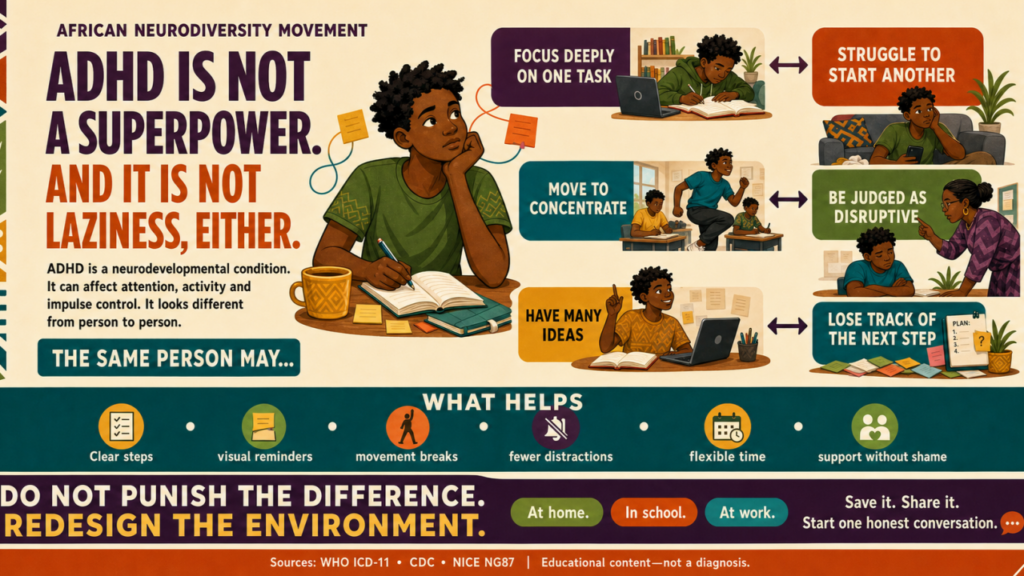
ADHD does not stay in one column
I recently saw a graphic with the words:
“Stop calling it a superpower.”
On one side of a glowing brain were hyperfocus, pattern recognition and creativity.
On the other side were task avoidance, sensory drain and masking exhaustion.
The image resonated because I recognised pieces of myself in both columns.
But real life is not split that neatly.
The same deep focus that helps me disappear into meaningful work can make it difficult to switch tasks or notice that I have skipped meals. The excitement that fuels a new project does not necessarily help me complete the repetitive administrative work that follows.
I can generate ten ideas before breakfast and still struggle to answer one important email.
The strengths and challenges are often tangled together.
The ability and the difficulty frequently arrive as a package deal.
The hyperfocus people admire might coexist with neglected responsibilities.
The creativity people celebrate might emerge alongside organisational difficulties.
The spontaneity people enjoy might exist alongside impulsive decisions that create stress later.
ADHD rarely stays in one column.
That is why reducing it to either a gift or a deficit feels inadequate.
Strengths are real. So is disability.
Rejecting the superpower label does not mean ignoring strengths.
At the same time, recognising strengths should never require us to ignore disability.
Creativity may be one of my strengths.
It is not a debt I owe in exchange for needing support.
I should not have to be exceptionally innovative before my struggles are taken seriously.
A child should not have to be academically gifted before receiving accommodations.
An employee should not have to produce extraordinary ideas before being allowed reasonable workplace adjustments.
Support should not be conditional upon exceptional performance.
The reality is that ADHD can interfere with education, employment, relationships, mental health and daily functioning.
Acknowledging that reality is not an attack on ADHD people.
It is an acknowledgement of why support, accommodations and understanding can be necessary.
Disability is not the opposite of dignity.
Pretending difficulties do not exist does not empower people.
Understanding them often does.
When positivity becomes another form of pressure
The superpower narrative can become harmful when it allows people and institutions to sound accepting without changing anything.
A school can celebrate a child’s “unique gifts” while continuing to punish unfinished work.
An employer can praise creativity while refusing flexibility, structure or accommodations.
A family can call someone talented while continuing to treat forgetfulness, overwhelm or disorganisation as character flaws.
That is not inclusion.
It is admiration without responsibility.
Sometimes positivity becomes another form of pressure.
If ADHD is always presented as a gift, what happens on the days when it feels difficult?
What happens when someone is overwhelmed, burned out, struggling at work or falling behind academically?
What happens when strengths are not enough?
No neurodivergent person should feel required to perform inspiration in order to receive support.
Strengths-based language should help us identify what enables a person to flourish.
It should never be used to deny impairment, dismiss treatment or avoid making meaningful changes.
Seeing the whole person means recognising both strengths and support needs.
This conversation looks different in African communities
We also need to be careful about importing social media narratives into African contexts without examining how they translate into everyday realities.
Africa is not a single culture, language, healthcare system or experience.
Yet across many African communities, families continue to face challenges related to awareness, stigma, access to assessment, specialist services and support.
For some families, the first challenge is simply helping others understand that ADHD is real.
A parent may be defending a child against accusations of poor discipline.
An adult may have spent years being told to pray harder, try harder or just become more organised.
Services may be distant, expensive or unavailable.
Schools may have limited understanding of neurodevelopmental differences.
Workplaces may not recognise accommodation needs.
In these contexts, calling ADHD a superpower can sometimes become another way of avoiding difficult conversations about healthcare, education, workplace inclusion and public investment.
African neurodiversity advocacy cannot simply copy conversations happening elsewhere.
It must be culturally grounded, family-aware and realistic about the barriers people face.
We can challenge stigma without pretending that affirmation alone replaces support.
What honest support sounds like
Honest support is both compassionate and practical.
It sounds like:
“You are not lazy. What part of this task feels difficult to start?””You have real strengths, and you are still allowed to need support.””Let’s write the instructions down.””Would movement breaks help?””Would a quieter environment help?””Would reminders make this easier?””You can explore assessment and treatment without shame.””You do not have to exhaust yourself trying to appear neurotypical.”
Support does not always begin with expensive interventions.
Often it begins with listening.
With flexibility.
With clearer communication.
With realistic expectations.
With believing people when they describe their experiences.
These changes may not remove every challenge.
But they can stop the environment from creating additional barriers.
Let people choose their own language
Some ADHD people genuinely love the word superpower.
If that language brings someone hope, confidence or self-acceptance, I am not interested in taking it away from them.
Self-description belongs to the individual.
The problem begins when that label is imposed on everyone, or when it becomes the only positive way ADHD is discussed.
I do not need my ADHD to be magical before my life is worth accommodating.
I do not need a tragic story before my struggles count.
I do not need to choose between being capable and being disabled.
I can be creative and stuck.
Confident and overwhelmed.
Productive and exhausted.
Focused and distracted.
Sometimes all in the same day.
What conversation should we be having?
Maybe ADHD is not a superpower.
Maybe it never needed to be.
Maybe the goal was never to convince the world that ADHD is secretly amazing.
Maybe the goal is something far more important.
Creating families, schools, workplaces and communities where ADHD people can thrive without having to earn understanding through exceptional talent or constant struggle.
We are not more worthy because we are creative.
We are not less worthy because we need support.
Acceptance without support is simply a kinder way of leaving people to struggle.
Support without dignity can become control.
We need both.
So perhaps the question is not:
“Is ADHD a gift or a disorder?”
Perhaps the better question is:
“What helps this person live, learn, work and belong?”
That question takes us somewhere useful.
And for many ADHD people, it takes us closer to the reality.
Through My Lens Reflection
If you live with ADHD, how can people recognise your strengths without dismissing your support needs? Share your perspective with ANM. Your experience may help another African adult, young person or family feel less alone.