Originally published in ANM’s Through My Lens LinkedIn newsletter on July 15, 2026. Republished here with the original author attribution.
Original LinkedIn edition: Read the source article on LinkedIn.
There is a conversation we don’t have often enough in workplaces across Africa: the hidden cost of masking.
As a neurodivergent person, one of the biggest challenges I have faced has not necessarily been the work itself. I love my job, and I work with individuals I relate to. I support individuals with learning disabilities, many of whom are autistic. It has been managing the anxiety, stress, and overwhelm that sometimes come with workplace expectations.
In a previous role, I was required to attend regular training sessions, probation reviews, and later supervision meetings with my manager.
Whenever the email arrived saying, “Your scheduled supervision date is…”, my anxiety would begin to build. Usually, it would arrive a week or two beforehand to give me time to prepare.
But, for me, it was time to work myself into a nervous breakdown.
There was no avoiding these meetings. If I wanted to keep my job, I had to attend.
Before every supervision session, training, or review meeting, I would rehearse conversations in my head. I would read forms repeatedly and prepare answers in advance. My nervous system would shift into fight-or-flight mode long before I entered the room.
I would tell myself:
“I can do this.”
“I need to do this.”
“The bills need paying.”
“I have responsibilities.”
Then I would push through.
Even during the middle of winter, I would sit through meetings drenched in sweat, trying to manage overwhelming anxiety while avoiding eye contact and appearing calm on the outside.
To others, I probably looked fine.
What people couldn’t see was the amount of energy it took simply to get through the meeting.
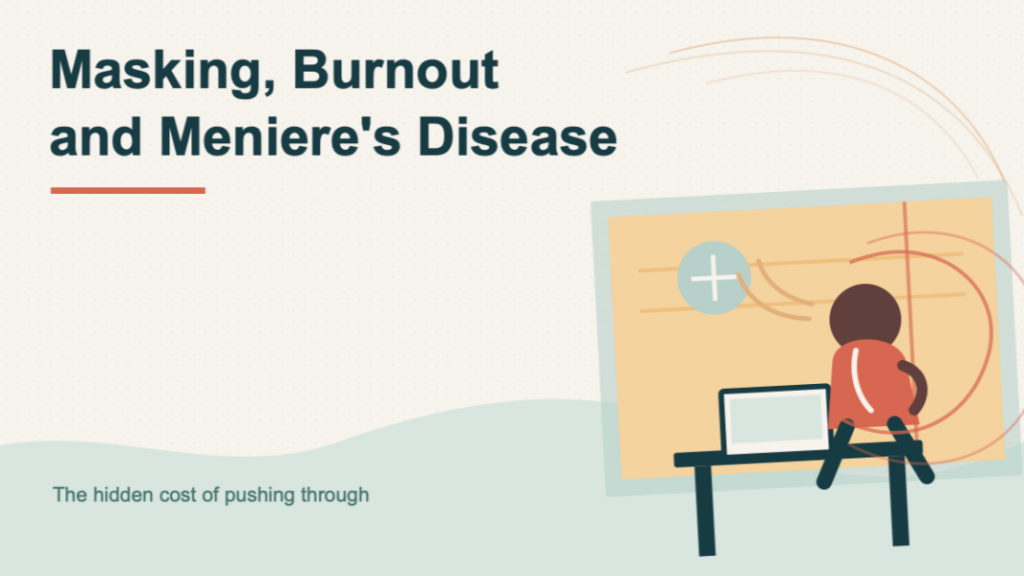
That is the reality of masking.
When Chronic Illness Enters the Picture
Later, I was diagnosed with migrainous vertigo and Meniere’s disease.
For me, that can involve:
Unpredictable and severe vertigo episodesTinnitusHearing lossEar pressure and fullnessNauseaSweatingLoss of balance
Episodes can last minutes, hours, or sometimes days.
One of the most significant triggers for a flare-up is stress.
After weeks of forcing myself through anxiety, meetings, training sessions, and workplace pressures, I would sometimes trigger a Meniere’s episode without even realizing how much strain my body was carrying.
Then another challenge would appear.
Sickness absence often leads to a return-to-work meeting.
For someone who already struggles with the mental and emotional demands of meetings, the anticipation of that conversation could become overwhelming in itself.
At times, I found myself needing additional recovery time, not because I was physically unable to return to work, but because I needed time to prepare emotionally and mentally for the process of coming back.
Why Reasonable Adjustments Matter
This is where workplace inclusion becomes more than a policy.
It becomes a lifeline.
A truly inclusive workplace should never force someone to choose between protecting their health and keeping their job.
Simple adjustments can make a significant difference.
These may include:
✅ Providing written information in advance
✅ Allowing written updates instead of attending every meeting
✅ Offering virtual meeting options
✅ Permitting a support person to attend meetings
✅ Providing additional processing and recovery time
✅ Applying flexibility around sickness absence and return-to-work processes
✅ Creating psychologically safe environments where employees can speak openly about their needs
These adjustments do not lower standards.
They remove unnecessary barriers.
Looking Beyond Performance
Masking can make someone appear resilient, productive, and capable.
But appearances can be misleading.
What looks like coping may actually be exhaustion.
What looks like resilience may actually be burnout building quietly beneath the surface.
Too often, organisations focus only on attendance, productivity, and performance metrics.
Inclusive employers look deeper.
They ask:
What support does this person need to thrive?
How can we make work sustainable, accessible, and humane?
Because inclusion is not about treating everyone the same.
It is about understanding that different people may need different kinds of support to succeed.
Every employee deserves the opportunity to contribute without sacrificing their well-being in the process.
Different Minds. United Africa. 💙✨
💙 Have you ever experienced masking, burnout, or a workplace adjustment that made a real difference?
Share your experience in the comments.
@africanneurodiversitymovement
Share this with HR professionals, managers, and leaders who are committed to building neuroinclusive workplaces.
#WorkplaceWednesday #ANM #NeuroInclusion #DisabilityInclusion #MenieresDisease #WorkplaceWellbeing #HumanResources #InclusiveLeadership #AfricanNeurodiversityMovement #DifferentMindsUnitedAfrica